
Start a Fulton Property Search
Most Fulton County searches start with an address. Plug it into the Fulton Property Map Viewer or the annual Tax Parcels data set. Either one returns a parcel record. Write down the ParcelID, the TaxYear, the situs address, the owner label, the subdivision, acreage, and any land-lot clues. When only a name is in hand, hunt for the parcel through tax data first, then test that name against the recorded deed index. No key bridges these systems better than the ParcelID.
Give each record the job it was built for. The assessor keeps the annual tax-roll view of every parcel. The Clerk handles deeds, liens, plats, surveys, and other recorded instruments. Bills and payments belong to the Tax Commissioner. City systems hold development records, while court and probate sources cover litigation and transfers after death.
- Find the parcel by address and retain its exact county key.
- Compare the tax owner label with the latest recorded deed grantee.
- Open the bill and assessment for the same tax year.
- Use GIS layers for spatial context, then recorded plats for legal clues.
- Check the correct city's permits and request any missing record from its custodian.
Fulton Property Records Custodians
Fulton County splits its property records among three custodians. Recorded instruments, including deeds, sit with the Clerk of Superior Court. The Board of Assessors keeps parcel and valuation records for Fulton County. The Tax Commissioner handles tax bills and payments. A request aimed at the right office the first time saves real effort. It also keeps one office's labels, such as a tax-roll owner, from being mistaken for another office's conclusion. That conclusion is about who holds title.
Fulton Clerk Real Estate Division
136 Pryor Street, Ground Floor
Atlanta, GA 30303
404-613-5313
Fulton Board of Assessors
235 Peachtree Street NE, Suite 1400
Atlanta, GA 30303
404-612-6440
Fulton's Parcel-to-Deed Path
The parcel and the deed answer different questions in Fulton County property records. The tax parcel gives you the practical search keys. The deed supplies the recorded legal trail. In the annual data, Owner is simply the tax-roll label. TaxYear dates that particular row. A freshly recorded deed can name a later grantee before the digest catches up. So keep both facts and their dates instead of treating either source as wrong. The official Tax Parcels service exposes the county's record fields directly.
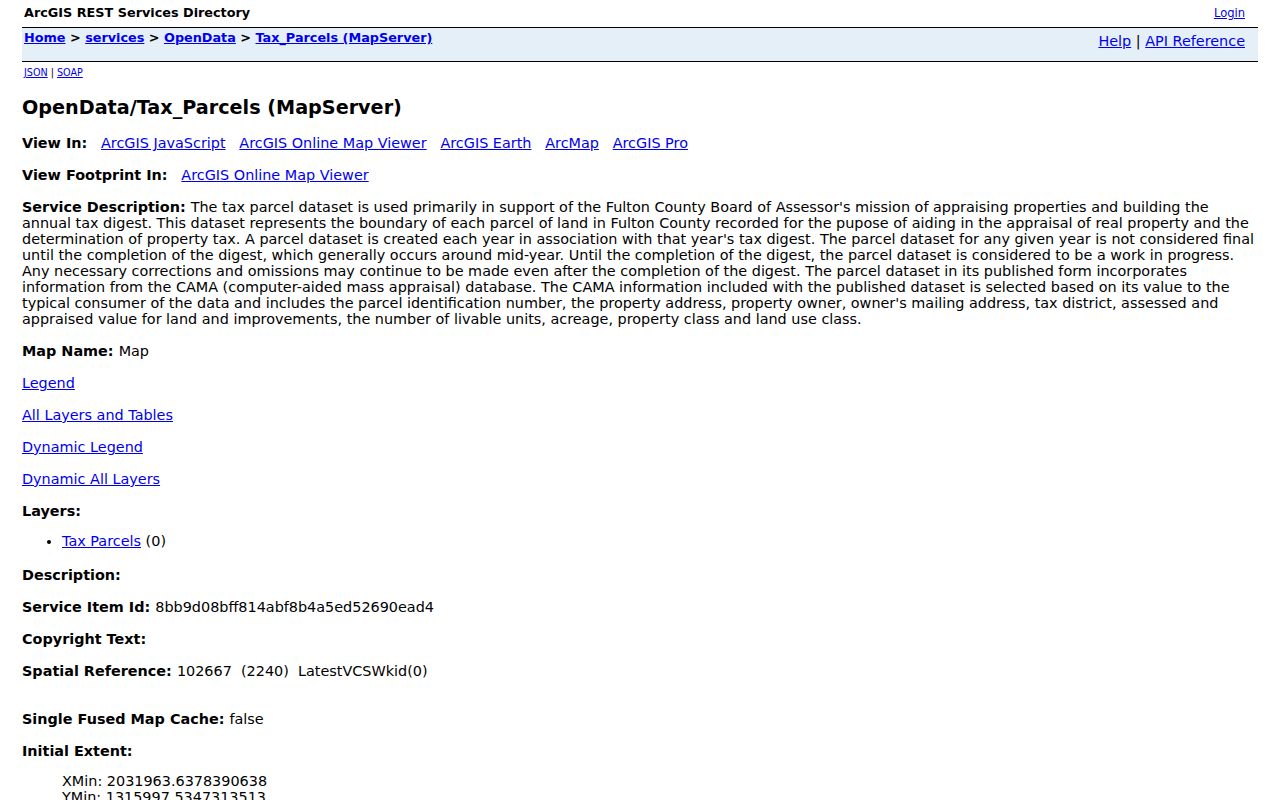
The Tax Parcels service page displays the full field list, including ParcelID, TaxYear, Address, Owner, land clues, and geometry. Save those values before opening the deed index.
Fulton County Land Record Types
Fulton County keeps its land records scattered across several offices, and its cities hold pieces of the same story too. Pick the record that fits the question at hand, whether that is a deed, a plat, or a tax roll, and remember each type answers only part of it.
| Record Type | What It Documents | Kept By | Access |
|---|---|---|---|
| Deeds and security instruments | Transfers, legal descriptions, and secured interests | Fulton Clerk | GSCCCA, Deed Room, copy request |
| Assessment | Annual owner field, parcel facts, values, exemptions | Board of Assessors | GIS, Open Data, notices, office |
| Tax bills | Millage, jurisdictions, payments, balance | Tax Commissioner | Bill search, phone, counter |
| Plats and parcels | Lot, block, land lot, geometry, easement clues | Clerk and GIS | Viewer, index, recorded image |
| Permits and zoning | Applications, status, inspections, planning cases | Municipality | City portal or records request |
Deeds are the backbone of any transfer trail. Tax and assessment records serve a different purpose, tracking annual public values and charges rather than ownership itself. Plats and GIS maps add spatial context, while permits show proposed or approved work but never establish who owns a parcel.
Fulton Values and Tax Bills
Fulton County assessment materials apply a 40 percent ratio. The assessed value on a parcel is four-tenths of fair market value. That figure is not a predicted sale price. The Tax Commissioner blends assessor data and exemptions with millage set by county, school, and city authorities. A single tax bill can pull from more than one taxing jurisdiction.
For 2026, Fulton announced August 15 mailing. September 30 due dates apply to Atlanta. October 15 applies to the county and other cities, with a digest-delay caveat. Notices can shift, so check the live property-tax page before you act.
The tax-bill search takes a full or partial parcel ID. It accepts an account number or a physical address. A Tax Summary request is stricter. It calls for the complete parcel ID. When a bill comes back, save the number, tax year, jurisdictions, appraised and assessed values, exemptions, and millage. Also record the gross and net amounts, due date, payment entries, interest, and balance. A paid bill is evidence of payment. It does not prove clear title. Search older years separately when the portal allows. The current account may not show every prior balance, predecessor parcel, or sold account.
Map Fulton County Parcels
Fulton County GIS layers cover parcels, address labels, land lots, ZIP polygons, subdivisions, zoning, future land use, schools, and flood and river context. Districts and road features round out the set. The service also supports identify, find, query, and map export operations. If you run a query, keep its layer, date, and source URL with the results.
A parcel polygon is a spatial index. It is not a survey or a boundary warranty. Use it to locate a lot and its neighbors. Then pull a recorded plat, deed, or current survey if a legal line or easement actually matters.
The Tax Parcels layer exposes each ParcelID and its polygon geometry. The ZIP layer stores a ZIP code plus preferred and alternate city labels. Those postal labels do not settle municipal jurisdiction. A permit, zoning, or tax-district question may turn on city limits. Compare the parcel against the municipal boundary in that case. For neighboring land, use identify or a defined buffer. Record each ParcelID and situs address. Then verify any claimed shared line through the plat or deed records. A visual touch on the screen establishes neither access nor an easement.
Fulton Deeds Across Time
Fulton County property records run deep. The Clerk's physical real-estate holdings stretch back to the early 1800s. On the GSCCCA statewide index, the baseline reaches at least January 1, 1999. Reindexing of older deed records continues. That statewide date is only a floor. Confirm Fulton's live Good From date directly rather than inferring it.
Some records never survived at all. Georgia Archives material notes that deed books B, F, and H were destroyed around 1880. Mortgage book E was lost with them. When a chain of title hits that gap, work around it. Use microfilm, plats, probate and court files, neighboring deeds, city directories, and Atlanta History Center tax plats. A missing transfer must stay a gap, never an assumed one.
GSCCCA Fulton Property Fields
The GSCCCA property search lets you filter by county, subdivision, unit, block, lot, and recording date. Controls let you page through results. The same portal offers separate modes for names, book and page, instrument type, and PT-61 data. Account status may affect image access. The search screen itself shows every one of those fields.
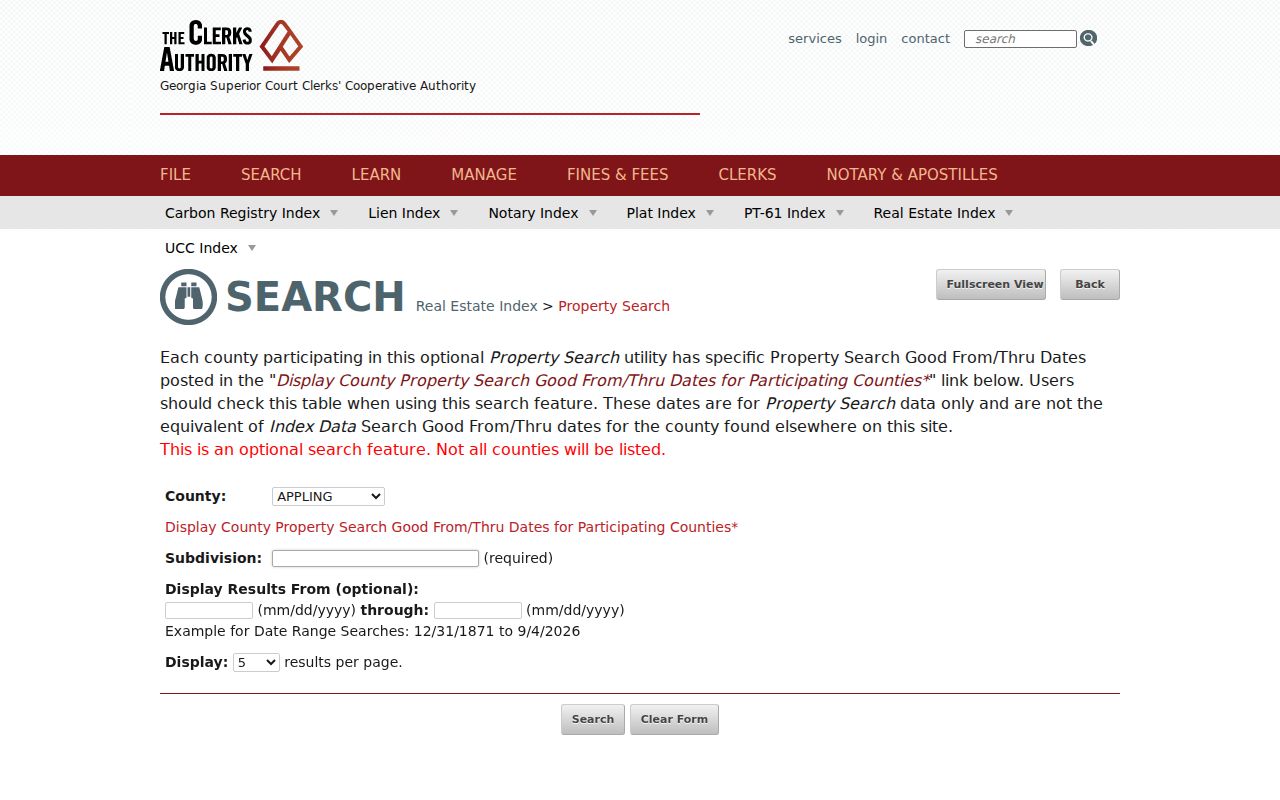
A common name gets manageable with subdivision and date filters. Book and page still matter, too. Use them to pull a deed that another instrument cites by reference.
Three Fulton City Permit Systems
Permits follow city lines, not county lines. Atlanta runs Accela and Property Info. Sandy Springs runs Build Sandy Springs on OpenGov. South Fulton uses SagesGov. Check the city in county GIS first. A ZIP code's preferred city proves nothing about jurisdiction.
City portals can return permits, planning cases, enforcement actions, inspections, and attachments. Keep the exact status word, whether submitted, issued, active, final, closed, or expired. The terms are not interchangeable. The permit applicant may not be the tax owner or the deed grantee.
Atlanta's tools cover address, parcel, owner, permit, planning, enforcement, and fire categories. Sandy Springs adds permit type, date, address, permit number, and project name. It also adds river, flood, buffer, easement, and planning layers. South Fulton's SagesGov screen offers record type, case or project number and name, status, several date ranges, address parts, and parcel number. No result? Try the county PIN, an old address, or a neighboring parcel. Then send a narrow written request. An empty building search may simply mean planning, public works, watershed, code, or a predecessor agency holds the record.
Watch Fulton Property Filings
Fulton R.E.A.A.C.T. sends email or text alerts. They fire when a document is filed against a ParcelID you register. GSCCCA FANS is another forward-looking route, matching selected criteria against transmitted index data.
An alert does not block a filing or hide a public record. Nor does it guarantee immediate, complete notice. Monitoring belongs inside an owner's or authorized person's own process. An unfamiliar alert should send you back to the actual instrument and the Clerk.
Pull the filing. Check grantor, grantee, instrument type, ParcelID, legal description, signatures, and notary details. Call the Fulton Clerk at 404-613-5313 for the record and routing help. Then bring in legal or law-enforcement help if the facts warrant it. Filing alerts are separate from address-confidentiality programs. VoteSafe shields qualifying residence information, while R.E.A.A.C.T. and FANS report index activity. Neither service makes a deed private or rules on a filing's validity.
Fulton Tax Sale Records
Fulton Sheriff materials describe a sheriff's tax deed as defeasible title. The deed comes with later redemption and bar steps. Buyer research requires a 50-year title certificate. Record the sale date, opening bid, sale price, purchaser, property description, recorded tax deed, redemption notices, and later instruments. Excess-funds notices offer party and transaction clues. They do not prove current ownership. Compare the parcel description against later deeds, releases, and court records.
Historic Fulton Property Sources
Fulton Library city directories span long runs of Atlanta and suburban address history. The Atlanta History Center holds tax plat maps dated 1946 through 1986 plus historic assessor-card material. Georgia Archives, Virtual Vault, and the Digital Library of Georgia open book, microfilm, and image routes, each with collection-specific gaps.
Start with the present PIN, land lot and district, subdivision, historic address, and name variants. A directory entry proves only that entry, not legal title. Date every clue, then return to the recorded instruments.
Appeal Fulton Property Assessments
Each year's assessment notice opens a 45-day appeal window. Fulton accepts SmartFile submissions and manual appeals by mail or hand delivery. The filing needs the PIN and property address. It also needs the selected method, estimated January 1 value, contact data, and a temporary-bill election. Photos and supporting documents can be uploaded.
Keep the notice, deadline, and filing confirmation. Keep the claimed value, evidence, method, temporary payments, decision, and any later court step too. The assessor handles appeals. The Tax Commissioner cannot change an appraised value through a bill inquiry.
Fulton Court and Probate Links
A deed search can spill into civil cases. Lis pendens, judgments, foreclosures, estates, and deeds of assent can all surface too. The Fulton Clerk case route reaches county court records. The Probate Records Division holds estate material. Search by party or case number, then tie any real-estate filing back by instrument citation.
Probate records do not replace deeds. A will, petition, order, executor appointment, or estate file can explain authority and timing. But the transfer trail must end at the Clerk's recorded instruments. Save the decedent name, estate number, dates, fiduciary role, and copy status.
Reach Fulton Records Offline
When an online image or result is missing, go through the custodian's other channels. The Clerk Deed Room offers a computer lab, historic custody, and downtown, North, and South service routes. The assessor maintains main and satellite offices. The Tax Commissioner handles account and payment requests. City departments take focused permit and zoning questions.
A strong request lists present and former address, ParcelID, party names and roles, subdivision, lot and block, land lot and district, instrument or case number, record series, and date range. Ask for an existing electronic record and a cost estimate. Phones work for routing only. Staff cannot run a title search for you.
Prepare for Fulton Archive Research
Some questions survive every portal. Old ownership, vanished streets, and pre-digital deeds often live only in archives. Fulton Central Library Special Collections keeps city directories and Georgia history material. The Kenan Research Center at Atlanta History Center offers property research aids and maps. It also holds tax plats and assessor-card context. For microfilm and digital collections, Georgia Archives and its Virtual Vault add routes. Coverage varies record by record.
Walk in prepared. Bring the current PIN, land lot and district, subdivision, old address, party-name variants, and a rough year. Ask staff for the finding aid, volume, box, or reel you need. Treat a directory or map as context, not title proof. Use its names and street clues to pick the recorded deed search back up.
Limits of Fulton Property Records
A single record proves only what it says. The tax roll names an owner of record. A deed names a grantee. A plat draws a parcel shape. No one document does everything. Recorded filings, annual values, tax bills, permit cases, and court events each answer their own narrow question. None of them guarantees clear title. None settles a legal boundary, confirms all work was built, or replaces a market appraisal. Keep every conclusion as narrow as the record behind it.
Lawful use. Fulton County property records support due diligence, boundary research, tax review, house history, estates, and civic transparency. Never use owner data to stalk, harass, or harm anyone.