
What Fulton County Deeds Convey
The Real Estate Division of the Fulton County Clerk of Superior and Magistrate Courts records every conveyance. Each one affects land in the county. A deed names the parties. It also fixes the interest placed in the public record. That matters more than a street address ever will. The legal description, execution date, recording date, stated consideration, parcel reference, and prior-deed citation do the real work. They connect one transfer to the next. Security deeds, liens, plats, and releases often sit beside the conveyance in the deed records index. Each answers a different question.
Instrument type matters too. A quitclaim makes no promises. A warranty deed does. A sheriff's tax deed carries redemption issues an ordinary sale never raises. Read the full recorded image before trusting an index label.
| Deed Type | What It Does | Common Use |
|---|---|---|
| Warranty deed | Conveys the stated interest with title promises written in the instrument | Conventional sale |
| Limited warranty deed | Limits the grantor's promises to a defined period or set of acts | Entity or managed-property transfer |
| Quitclaim deed | Conveys whatever interest the grantor has without a broad title promise | Interest cleanup or intra-family transfer |
| Executor, administrator, or assent deed | Moves an estate interest through a fiduciary or assent process | Transfer after death |
| Sheriff or tax deed | Records an interest arising from a forced or tax sale | Levy sale, subject to further title work |
Searching Fulton County Deed Records
One doorway covers nearly everything. The statewide GSCCCA Real Estate Index leads into Fulton County deed records through several routes. Name Search fits when a grantor or grantee is known. Property Search narrows by county and subdivision details, and Book/Page Search jumps straight to a cited instrument. Instrument-type and PT-61 functions offer focused paths, though image access can depend on the account level.
| Search control | Use in a deed search | Important limit |
|---|---|---|
| County | Choose Fulton to keep results in the correct recording office | Required for a county-specific property query |
| Subdivision, unit, block, lot | Match a recorded plat or legal description | Spelling and phase labels must match the index |
| Good From / Thru | Set the recording-date window | Fulton's earliest live value must be checked in the portal |
| Book and page | Retrieve a document already cited by another deed | An image may require account access |
| Results per page | Controls review of a long result set | Does not change underlying coverage |
The GSCCCA property-search screen shows how those fields are arranged.
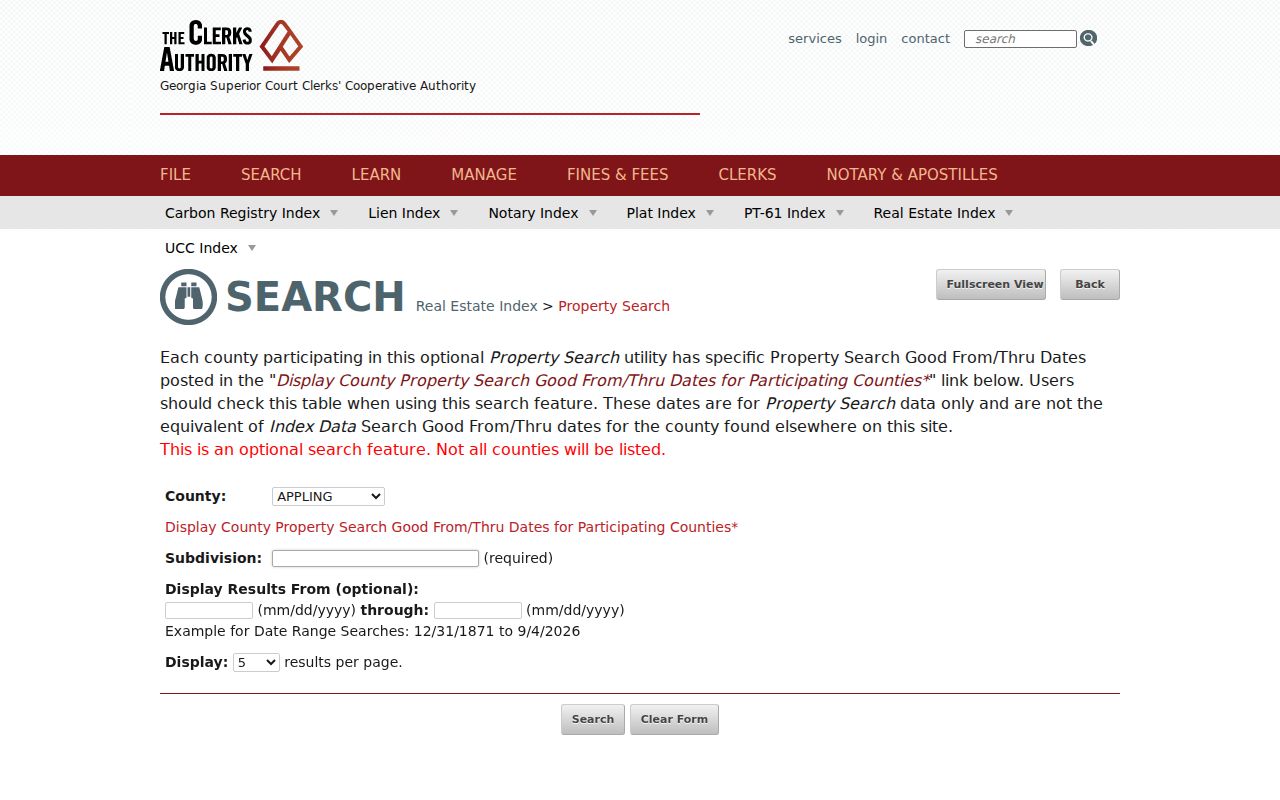
The search screen displays subdivision and date filters plainly. That layout is a reminder to gather the parcel key and legal-description clues before starting a Fulton County deed search.
Follow Fulton Grantors and Grantees
A chain of title is the ordered run of instruments that ties every transfer of the same land together. The grantee receives the interest. The grantor conveys it. Begin with the newest well-matched deed record, then test each earlier link against the legal description instead of assuming a repeated name means the same parcel.
- Use Fulton GIS or the annual tax parcel data to save the address, PIN, subdivision, lot, block, land lot, district, and current tax-year owner label.
- Search the apparent owner as a grantee. Open the plausible deed and record its grantor, dates, instrument or book and page, and legal description.
- Search that grantor as a grantee in the prior period. Repeat name variants for individuals, estates, trusts, and entities.
- Use cited book/page references, plats, and later corrections to test continuity. Record a gap when the land description does not match.
- Search forward for corrections, later deeds, security instruments, cancellations, liens, estate filings, and tax deeds.
- Grantor
- The party conveying the stated interest.
- Grantee
- The party receiving that interest.
- Chain of title
- The linked sequence of recorded transfers for the same land.
- Book and page
- A traditional recorded-document citation.
- Instrument number
- A unique recording identifier used to retrieve a filing.
The Fulton PIN Cross-Check
Georgia House Bill 1036 required a tax PIN on real-property documents beginning August 27, 2018. For newer Fulton County deed records, that makes the assessor map a strong first stop. The PIN joins the tax parcel, deed, and GIS map neatly. It cannot replace the instrument's legal description. Splits, consolidations, replats, and address changes can spawn predecessor or successor parcel numbers without warning.
Record both the displayed PIN and the recording citation. Some older deeds carry no PIN. Fall back on its land lot, district, subdivision, lot, block, acreage, adjoining tracts, and prior deed reference. Those clues outlast street renaming far more often than a mailing label does.
Fulton's Early Deed Books
The Fulton Deed Room holds physical real-estate records dating to the early 1800s. GSCCCA's statewide operational baseline reaches at least January 1, 1999. Historical reindexing keeps adding older entries. That does not set a Fulton-specific online start date. Check the live Good From and Thru display before quoting any exact range.
A documented local loss complicates the older trail. Georgia Archives research material reports that deed books B, F, and H and mortgage book E were destroyed. They landed in a courthouse well around 1880. A missing book is not proof that no transfer occurred. It is a prompt to compare records. Use Archives microfilm and Virtual Vault material, recorded plats, probate files, court papers, neighboring deeds, Fulton Library directories, and Atlanta History Center tax plats.
Coverage matters. Physical custody reaches the early 1800s, but online coverage and surviving book coverage are different facts.
Fulton's Virtual Deed Books
The Clerk reports more than 384,878 documents and 1,154,172 pages each year. Those filings go into roughly 1,254 virtual deed books. Figures on that scale explain why a precise instrument list beats a broad request. The Real Estate Division also notes that an eRecorded document reaches the Clerk and GSCCCA in about two to three business days. Normal processing may run longer.
Recording speed is not a title guarantee. Note when the deed was signed. Note when it was filed. Also note when it reached the deed records index. Those dates can differ. A later tax-roll owner of record label may reflect a separate annual digest cycle as well.
Note: Treat each date as a distinct labeled event, never as one interchangeable sale or ownership date.
Records Beside Fulton Deeds
Fulton County deed records never stand alone. Plats, surveys, condominium plans, security deeds, assignments, modifications, releases, liens, lis pendens, and correction instruments can each change how a transfer reads. Plats and plans have been electronically filed since January 1, 2017. Older examples may require the Clerk, GSCCA, Georgia Archives, or Atlanta History Center.
A lien hit must be traced to its release, cancellation, order, or later related instrument. A plat deserves the same care. Check the phase, lot and block, streets, easements, common areas, and replats. No tax parcel row can display all of those recorded limits. The focused Fulton property search supplies the parcel key. The deed index supplies the legal trail.
Fulton Filing Alerts
Want early warning about filings? Owners can register for Fulton R.E.A.A.C.T., the Clerk's Real Estate Activity Alert and Contact Tool. It sends an email or text. Each alert fires whenever a document is recorded against a ParcelID you enroll. Prefer a statewide net? GSCCCA FANS works from clerk-transmitted index data and alerts you on criteria you select.
Remember that both services only watch forward. Neither stops a filing, hides a public deed, or promises instant, complete notice. An unfamiliar alert deserves a close look. Pull the recorded instrument. Compare the parties, PIN, legal description, signatures, and notary block before calling the Clerk or a professional. Alerts belong to owners and their authorized representatives.
Order a Fulton County Deed
You have several ways to get a Fulton County deed. The index and many images sit online for viewing. Prefer in-person research? The Deed Room computer lab at the Lewis R. Slaton Courthouse offers four hours of access for $5. It sits on the ground floor at 136 Pryor Street in Atlanta. Hours are weekdays from 8:30 a.m. to 5 p.m. The North and South service centers add counter options elsewhere in the county. For access or status questions, call 404-613-5313, though the line is not for legal research.
A mailed order should spell out the instrument type. Include the book and page or instrument number, your return details, and whether you want a plain or certified copy. Fulton separates self-service from clerk-assisted pricing, so no single plain-copy quote fits every request. Confirm the current schedule and page count before sending payment.
Recorded, not guaranteed. The index reports filed instruments. It is not a title opinion, and a full title review may require deeds, liens, judgments, taxes, estates, surveys, and later filings.
File every copy with its type and certification status noted. An index printout, plain image, certified copy, and screenshot serve different purposes even for the same deed.