
Trace Former Fulton Property Owners
A backward deed chain begins with a known current deed. From there, follow each grantor to a prior deed. That deed shows how the party first acquired the land. Every row in the timeline represents a documented transfer. Nothing here is a guess about who lived in the house. Keep the chain anchored with the legal description and the book/page or instrument reference. That way the trail never drifts off the Fulton parcel you started with.
| Transfer Date | Grantor to Grantee | Deed Type | Book/Page |
|---|---|---|---|
| Newest matched recording | Prior owner to current grantee | As printed on instrument | Exact reference |
| Next earlier recording | Earlier owner to prior owner | As printed on instrument | Exact reference |
| Earlier book entry | Earlier grantor to grantee | As printed in book/index | Volume and page |
| Unresolved interval | Do not infer parties | Record source gap | List pivots checked |
Execution and recording dates can differ. Record both whenever they appear. A quitclaim, correction, tax deed, executor deed or deed of assent can carry a different kind of interest than an ordinary sale. Label the deed type in each row instead of flattening every transfer into "sold."
Fulton’s Online Ownership Cutoff
The GSCCCA Real Estate Property Search carries a statewide operational baseline. That baseline goes back to at least January 1, 1999. Historical reindexing has added older records over time. Even so, the exact Fulton Good From and Thru range remains an open question. The live portal answers it only per search. Before assuming every Fulton deed since 1999 sits online, check the county coverage the GSCCCA property search displays on screen.
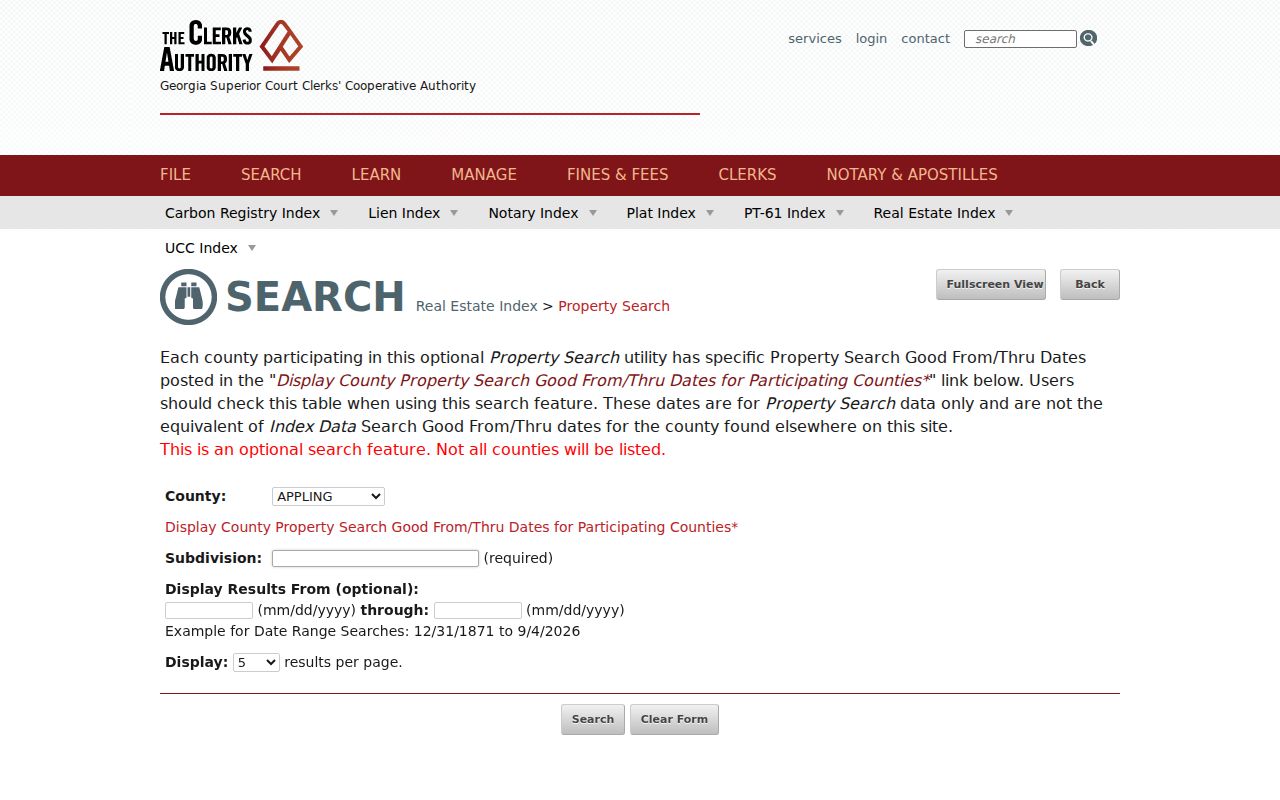
The county, subdivision and date controls will narrow a backward search considerably. Each hit still needs its instrument and legal description checked before it enters a former-owners timeline.
Coverage limit. Treat 1999 as a statewide baseline, not a guaranteed Fulton cutoff. Older owners may require deed books, microfilm and archives.
Walk Fulton’s Deed Chain Backward
Begin only after the current parcel and newest conveyance match. Search the grantee from that deed as a grantee in an earlier date range. The deed by which that party acquired the land should name the next prior grantor. Repeat the process. Continue while the legal description stays consistent.
- Use Fulton GIS to save the current PIN, subdivision, lot/block and land lot/district.
- Find the current acquisition deed. Copy grantor, grantee, execution date, recording date, deed type, legal description and reference.
- Search the grantor as an earlier grantee. Try name variants, entity names and book/page links while matching the land.
- Continue deed by deed. At the online edge, carry the last solid reference into the Fulton Deed Room or archival catalog.
- Grantor
- The party conveying the stated interest.
- Grantee
- The party receiving the stated interest.
- Chain of title
- The linked sequence of conveyances affecting the same land.
- Reverse index
- An index route used to search backward from a known owner or grantee.
- Quitclaim and warranty deed
- A quitclaim conveys the grantor's interest without the same covenants associated with a warranty deed.
Continue Fulton History Offline
The Fulton Clerk Deeds and Records room holds physical instruments dating to the early 1800s. Counter service is available downtown. It is also available at the Deed Room computer lab and at the North and South service centers. The clerk will not conduct legal research by phone. A $5 charge covers four hours of computer research in the Deed Room.
Bring a written list of former owners, name variants, and approximate dates. Include subdivision and lot, land lot and district, and the last known book/page. For a mailed request, identify the instrument type and reference plus return details. Plain-copy pricing differs on official pages depending on the self-service or assisted route. Confirm the current schedule before quoting any fee.
Bridge Fulton’s Destroyed Deed Books
A Georgia Archives handout from the Atlanta area reports that Fulton deed books B, F and H were destroyed. So was mortgage book E. The handout says they were thrown down a courthouse well around 1880. That loss explains the gap. Some former-owner chains cannot be closed by turning to the next volume. The page is simply gone. Work around it instead of guessing.
Never invent the missing conveyance. Compare adjacent deeds, subdivision plats and tax plats. Then use directories, probate files, court records, newspapers and annexation sources. A credible reconstruction relies on several independent clues. Their land-lot, legal-description and address context should all match. Label each clue for what it is: tax, occupancy, map, probate, court or title evidence.
Find Earlier Fulton Owner Clues
The Atlanta History Center Kenan Research Center holds Fulton tax plat maps from 1946 through 1986. The center also keeps historic assessor cards, Sanborn maps, Adair Realty plats and files covering more than 240 Atlanta neighborhoods. Fulton Library's city and suburban directories run from nineteenth-century volumes through 2016/17 cross-reference material.
These collections shine when a street was renamed. They also help when a house number changed or an old neighborhood label disappeared. Start with the current PIN. Decode the district and land lot, then compare maps and directory years side by side. Remember that an owner printed on a tax plat is only a lead to the deed index. The same goes for an occupant listed in a directory. Neither is a substitute for a deed.
Resolve Fulton Estate Transfers
A clean sale-to-sale chain can pause at death. Search Fulton Probate by decedent or estate case first. Then look for an executor or administrator deed, a deed of assent, a court order, or a later conveyance in the Clerk record. A will filed with Probate does not itself replace the recorded land instrument.
Preserve the fiduciary capacity printed after a name. An administrator, executor, trustee or heir may appear in different records for different reasons. Match the estate authority to the deed. Then match it to the parcel before adding any prior owner to the chain.
Use Fulton Plats as Time Markers
A subdivision plat or replat can explain why an old deed describes a parent tract. The current parcel may instead carry a new PIN. Fulton plats have been electronically filed since January 1, 2017. Older plat books and archival collections vary widely. Record the subdivision, phase, lot, block, land lot, district, streets, easements and amendment references.
Adair Park offers a concrete example. Its Land Lots 106 and 107, along with the Atlanta Real Estate Company subdivision of 1910 to 1912, create a map-to-deed lead. That lead points toward former owners. The subdivision story narrows the records. It does not prove any person held a particular lot.
How Far Fulton Owner Records Reach
Physical records in Fulton County reach back to the early 1800s. The online statewide baseline starts much later. Fulton's online deed records have an exact depth. That depth must be verified live before you trust it. For older parcels, the Georgia Archives microfilm, the Virtual Vault, and the Digital Library of Georgia can extend your search into earlier deed books. Treat no catalog or digital collection as complete without checking its volume range. Gaps are common.
End the chain of former owners honestly when the evidence runs out. Record the last confirmed deed. List every source and date range you searched. Record the reason the trail stopped. A note reading "not found in the inspected source and date range" is accurate. A claim that no prior owner ever existed is not.
Lawful use. Former-owner research supports house history, estate work and title diligence. Never use historic records to track, harass or expose a living person.