
Inside Fulton Property Tax Records
Fulton builds its property tax records in stages. First the Board of Assessors appraises each parcel. That office also maintains the digest, administers exemptions, and handles appeals. The Tax Commissioner then takes the value and exemption data and applies millage set by county, school, and city authorities. The Commissioner issues the bill and collects it. Every figure needs its label, tax year, and source office.
| Field | What It Shows | Where It Lives |
|---|---|---|
| Fair market or appraised value | The assessor's annual estimate under the stated tax-year method | Board of Assessors notice and roll |
| Assessed value | Forty percent of fair market value under Fulton's stated convention | Assessment record and notice |
| Exemptions | Approved reductions that affect taxable value | Assessor record and bill input |
| Millage and jurisdictions | Rates from the county, schools, city, or other taxing bodies | Tax Commissioner bill |
| Payments and balance | Charges, due date, receipts, interest, and amount still due | Tax bill and account history |
A sale price is a different number entirely. It may show up in a deed or PT-61 record. That price is not the fair market value, the assessed value, the taxable value, or the tax due on any bill.
Find a Fulton Tax Bill
The official Fulton tax-bill search accepts a full or partial parcel ID, account number, or street address. Parcel ID is the cleanest key. Addresses get abbreviated, reassigned, or tagged with the wrong city label. A Tax Summary request requires a complete parcel number.
- Find and save the ParcelID and TaxYear in Fulton GIS or the annual tax-parcel dataset. Confirm that the situs address describes the intended land.
- Run the bill search with the parcel ID. If needed, retry with the account number or a normalized physical address.
- Save the bill year, bill number, taxing jurisdictions, appraised and assessed values, exemptions, millage, gross and net tax, due date, payments, interest, and balance.
- Compare the bill with the assessment notice. Search earlier years separately rather than assuming the current result contains the full account history.
- Assessed value
- The stated portion of fair market value used in Georgia's tax calculation.
- Millage
- A tax rate expressed in mills and applied by the taxing jurisdictions.
- Homestead exemption
- Approved relief for a qualifying owner-occupied home.
- Tax lien
- A recorded or statutory claim tied to unpaid tax, which requires its own status check.
Fulton Parcel Fields to Save
Fulton's Open Data tax-parcel service offers a reproducible field set before you open a bill. Useful labels include ParcelID, TaxYear, Address, Owner, mailing fields, tax district, acreage, class or use, exemptions, subdivision clues, and geometry. Treat it as an annual digest. It is not a certified account statement. The official Tax Parcels service publishes the field structure for cross-checks.
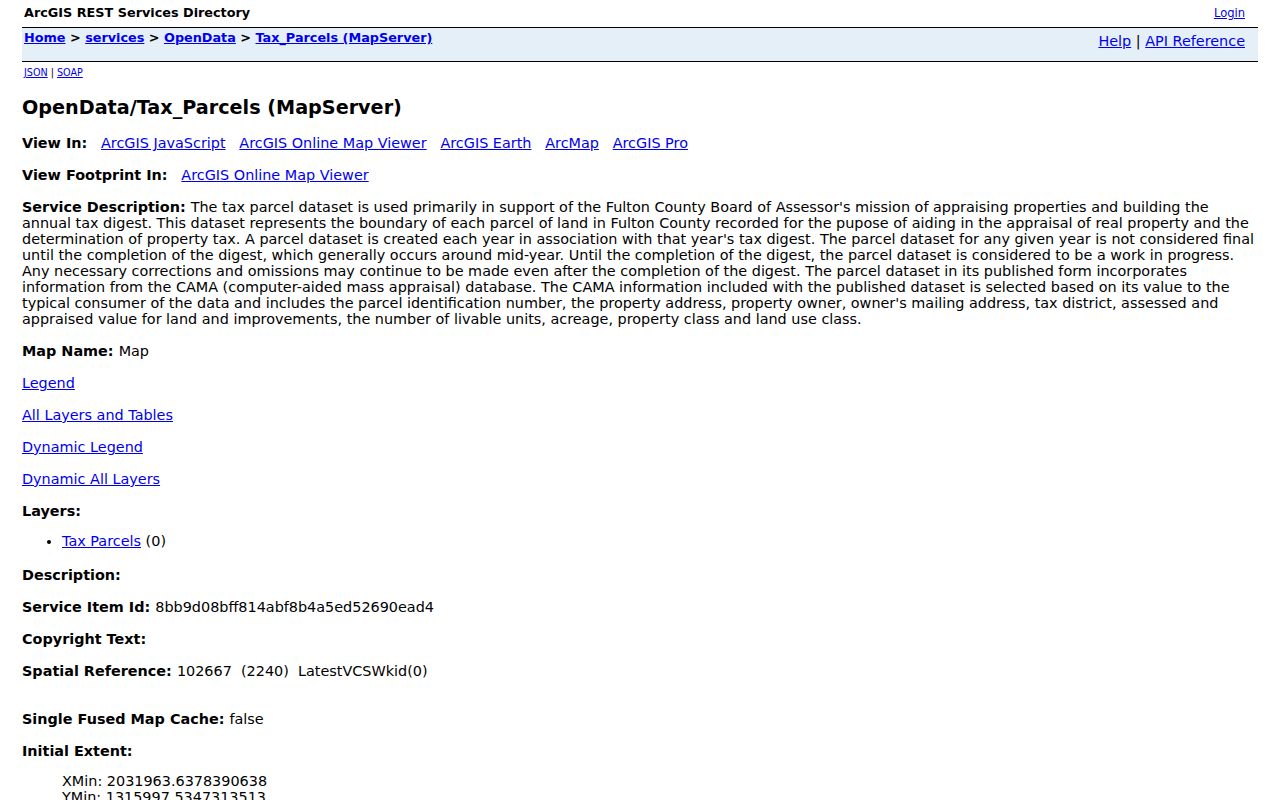
The Tax Parcels service pairs a parcel number with owner, address, class, acreage, and subdivision data. The tax year belongs there too. Loose values do not compare safely.
How Fulton Assesses Property
Fulton County assesses every parcel annually at fair market value. The source is the Board of Assessors' assessment materials. The office frames fair market value as the price a willing seller and willing buyer would strike. It then applies a 40 percent ratio to reach assessed value. The ratio is just a convention. It will not predict what a property actually sells for.
The annual report anchors each appraisal to market conditions on January 1, drawing on prior-year data. The digest stays open as a work in progress into mid-year. Values can be corrected even after release. Before comparing two years, note the tax year. Also note the notice date, the source date, and the exact value label on each figure.
Fulton Tax Exemption Clues
Fulton homestead and special exemptions can shrink taxable value without touching the underlying fair market estimate. Listed categories include homestead, low-income, senior, disability, agricultural, forest, and environmentally sensitive programs. A displayed exemption proves neither occupancy nor title.
Most listed exemptions renew automatically. The Fulton County Low Income exemption is different, renewing every two years. A transfer of ownership requires refiling. A new split may lack a PIN. Until the parcel key exists, the assessor provides a manual route for the subdivision. SmartFile also handles returns, appeals, and mailing-address changes.
Note: Save the exemption code and tax year instead of forcing an unsupported ownership conclusion.
Contest a Fulton Assessment
Every Fulton annual assessment notice opens a 45-day appeal window. The Board of Assessors appeal route accepts online SmartFile filings plus manual submissions by mail or hand delivery. The filing asks for the PIN, property address, phone, estimated January 1 value, supporting evidence, and a method such as Board of Equalization, Arbitration, or Hearing Officer. The form also carries temporary-bill election fields.
Keep the whole paper trail. That means the notice date, deadline, confirmation, claimed value, method, uploaded evidence, temporary payment record, decision, and any Superior Court step. Photos, comparable sales, repair evidence, and maps can all help. The right proof depends on the appeal's basis.
Appeal window. Count the 45 days from the notice and preserve proof of filing; a tax-bill complaint sent to the wrong office does not protect the deadline.
Fulton 2026 Tax Timing
Fulton mailed 2026 bills on August 15. Atlanta bills were due September 30, and county plus other city bills were due October 15. Interest starts the day after the applicable due date. The same announcement carried a digest-delay and temporary-collection-order caveat. Check the live Tax Commissioner page before acting on any date.
Pay online by card or e-check, by mail, in person, or by phone. Save the confirmation number, amount, method, date, parcel or account, and bill year. A receipt proves that payment event alone. It is not a certified tax-clearance statement.
Fulton Tax Sales and Excess Funds
Under the Sheriff's tax-sale materials, a Fulton levy sale ends in a sheriff's tax deed. That deed carries defeasible title. Buyers are directed to obtain a 50-year title certificate. Redemption and bar procedures can still follow the sale. State rules require the deed and transfer-tax form to be recorded within 30 days. A tax-sale entry is never an ordinary clean transfer.
A careful record pulls the sale date, opening bid, sale price, purchaser, property description, deed citation, and redemption notices. It also pulls any later bar or prescription instruments. Excess-funds notices can supply the purchaser, price, excess amount, and description. Yet they still do not prove who owns the parcel today. Match the parcel number first. Then trace later deeds, releases, and court records for the true owner of record.
Title limit. A paid bill, unpaid balance, or tax deed does not by itself establish clear and marketable title.
Build a Fulton Tax Request
Start a Fulton tax request with the basics. Include the parcel ID, account number when known, physical address, tax year, and the precise subject. Say exactly what you need. Ask for a bill copy, payment history, refund, exemption credit, delinquency, tax sale, tax certificate, or interest calculation. Ask for the jurisdiction breakdown as well. Preserve the office's own field names when you copy them. Compare the account against assessor TaxYear data to keep the tax roll aligned. Then check recorded split, consolidation, deed, or plat references that might affect the parcel.
Search prior years one at a time when the portal allows it. A current bill proves nothing about the past. Old balances can hide behind a new key. Sold parcels, merged accounts, and predecessor parcel numbers can too. Need proof of paid taxes? Request the specific certificate or receipt and keep its issue date.
Request Fulton Tax Records Offline
The portal is not the only route. Call the Tax Commissioner at 404-613-6100, or visit 141 Pryor Street SW in Atlanta. State the purpose up front. You might need a bill copy, account balance, payment, refund, exemption credit, delinquency, tax sale, or tax certificate. Give the parcel ID, account number, physical address, and tax year. Add the owner label if you know it. Ask for the jurisdiction breakdown and any interest or penalty calculation. Closing or title matters need the precise certificate or paid receipt. Retain the office's wording and its issue date. The assessor at 404-612-6440 handles value, exemption, appeal, and digest questions instead. For a broader parcel lookup before the bill, use the Fulton property search.
Any Fulton County property tax comparison needs discipline. Retain the same field across years. A shift in taxable value may trace to an exemption. A shift in assessed value may reflect the annual appraisal instead. Payment changes often come from millage or jurisdiction shifts. Write down the source year and label before calculating any trend. If an address changed, use the ParcelID. Then check predecessor or successor accounts on the tax roll. A split parcel can hide the old bill. It may not appear beneath the current key. These checks keep Fulton tax history tied to the right land. They also stop a new account from looking like a gap.